
Flint Township Previous Residents by Era
Different sources answer different parts of a house history. Assessment and deed records establish a parcel and recorded ownership. Directories and census schedules can identify a household. Maps and aerials explain a structure or street pattern but do not name an occupant. This distinction keeps the search for previous residents tied to evidence rather than assumptions.
| Source | Years It Covers | Where Held | What It Shows |
|---|---|---|---|
| BS&A property and tax record | Current parcel and tax record; exact historic coverage unverified | Flint Township assessment portal | Owner, situs and mailing address, parcel number, legal description, values, and linked records when displayed |
| Recorded land instruments | Online records before 1983 are unavailable | Genesee County Register of Deeds | Grantor, grantee, instrument, date, and legal-description trail |
| Flint directories | 1894 digitized volume verified; other local runs need confirmation | Google Books/U-M and local history contacts | Names, addresses, occupations, and household leads |
| Federal census | Public through 1950 | NARA and authorized research access | Household composition, age, birthplace, occupation, and enumeration geography |
| Sanborn and historical aerials | Sanborn 1914; aerials 1937-1997 | Library of Congress and Genesee GIS | Building, lot, road, and landscape context, not a person list |
| Obituary and probate trail | Date and collection dependent | Library, Historical Society, and Genesee court records | Death, family, former-address, estate, and heir clues where available |
Begin with the source nearest the period in question. A recent transfer usually starts at the parcel and recorder. A household from an older decade may instead need a directory or census, then a deed search to confirm the address.
Each source has a different limit. An owner can live elsewhere, a directory can omit a household member, and an obituary can contain a family error. Keep the date of each item beside the address. A record trail is strongest when independent records agree on the same parcel, household, and period rather than merely repeating a surname.
Flint Township Previous Residents Begin at Parcel
Use the Flint Township BS&A property portal to locate the exact situs address. Save the owner name, tax mailing address, parcel number, legal description, assessment year, exemption flag, and map link when those fields appear. The mailing address can be useful for finding a record, but it is not proof that the recipient lived at the property. The parcel card is an ownership and assessment record, not a household roster.
Address-to-history trail: current parcel card → parcel geometry and aerial views in Genesee GIS → owner and legal description → recorded deed → prior seller or grantee → earlier deed books, directories, and census. The map helps hold the search on the same land when a street number, road pattern, or place label changes.
FetchGIS materials describe parcel maps, aerial years, contours, measurement, coordinates, and report tools. Select the parcel, keep its legal description and nearby parcel numbers, then compare them with the deed. County GIS warns that map data is not a legal survey or legal record.
Flint Township Deed Chain Walkback
The recorded chain follows the property rather than a guessed household. Search the current owner or legal description in the Genesee County official-records search, capture the latest deed, and use the seller from that deed as the next name to search. Compare the legal description each time. Similar street numbers and subdivision names can otherwise send a search into the wrong chain.
- Pull the current property card and record the parcel number, legal description, situs address, and owner exactly as shown.
- Locate the latest recorded instrument that conveys the matching legal description, then note its date, document number, and both parties.
- Use the seller from that deed as the prior grantee search, checking that the same parcel or lot description remains in view.
- Repeat the buyer-to-seller sequence backward, keeping plats, subdivision names, and adjoining parcels nearby for comparison.
- When the date falls outside online access, ask for the applicable historical index, book, microfilm, or onsite image route.
- Grantor
- The party transferring an interest in a recorded instrument, often the seller on a deed.
- Grantee
- The party receiving that recorded interest, often the buyer. A deed proves a transaction, not residence.
- Legal description
- The lot, block, subdivision, metes-and-bounds, or other land description used to identify the parcel more reliably than an old street address.
- Chain of title
- The sequence of recorded transfers connected to the same property. It may have gaps or records that require office access.
Capture the instrument type, recording date, document number, book or page where applicable, legal-description wording, and copy or image status. Mortgages, liens, releases, and deeds can all appear in the index, but only a conveyance should be treated as a transfer. A recorded deed identifies the parties to that transaction, not everyone who occupied the address.
Flint Township Previous Residents Before 1983
The Register of Deeds states that records before 1983 are not accessible online. Books 1736-1772 have images but no name index. That split matters when tracing past residents because an early deed may be preserved yet still require a historical index, a book search, microfilm, a Laredo-supported route, a counter visit, or a focused records request.
The second digitized Flint Michigan City Directory item can provide a household lead when the deed trail reaches an older period.
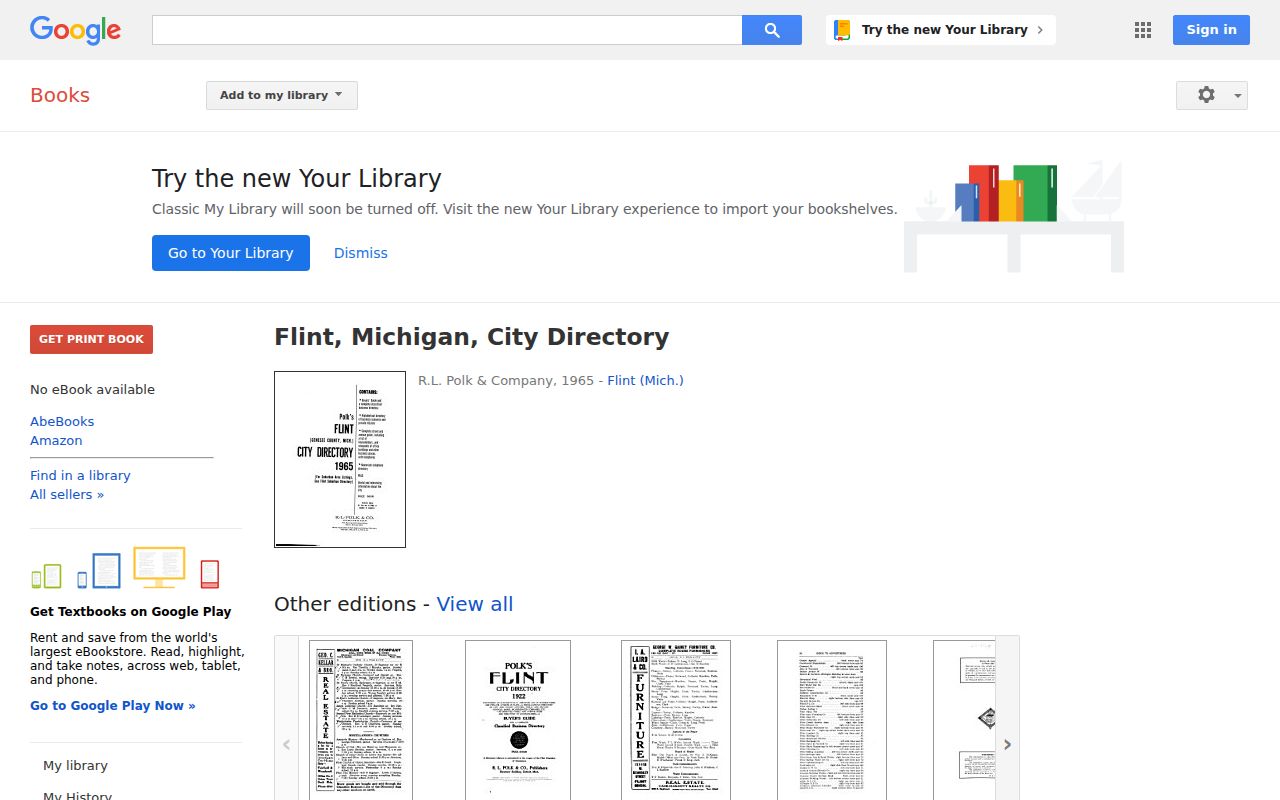
The digitized volume is useful for names and address clues, but it does not replace the older deed-book route. For the Register, ask whether a specific Flint Township grantor/grantee volume, plat, or image is available onsite. The office is at 324 S Saginaw Street, Suite 1A, Flint, and its published phone is 810-257-3060.
Published copy charges are $1 per page, and a certified copy adds $5 plus $1 per page. Confirm the current charge and the available book before ordering work on a difficult historical search.
The online boundary is an access rule, not a date when record keeping began. A pre-1983 transfer may be reachable through an onsite image or book even when it does not appear in the public online search. Give staff the parcel, legal description, names, and a narrow date range so they can direct the request to the right historical route.
Pair Flint Township Previous Residents With Census
Owners are only part of the story. A city or reverse directory may place a listed occupant at an address, including someone who was not the deed owner. A census then supplies a public household snapshot through 1950. The local reverse-directory shelf and year run are not verified, so request them from McCarty or the Historical Society instead of assuming a street section exists for every year.
Read a directory entry with its address, spouse marker, occupation, and employer line when present. Pair it with a nearby census year and the deed trail. A matching surname alone is weak evidence; an address plus a spouse, work line, or parcel description is much stronger. The collection details belong with the Flint Township city directory records.
Flint Township Previous Residents and 1914 Sanborn
The Library of Congress Sanborn search guide helps researchers locate and read the 1914 Flint fire-insurance set. The collection has 102 sheets. It can show building footprints, construction material, lot lines, uses, and numbered addresses, which is valuable context for a parcel or a changed street pattern.
A Sanborn sheet is not proof of ownership or occupancy. Use it to frame the next record search, then confirm people through a directory, census, deed, obituary, or probate file. Genesee County's aerial years, from 1937 through 1997, offer a second way to see physical change without turning the image into resident evidence.
Note: A road or structure change seen on a map should lead to a parcel or permit check, not a conclusion about who lived there.
Flint Township Previous Residents at Old Addresses
Flint Township is not the City of Flint, even when a mailing line, ZIP code, or nearby record uses “Flint.” Assessment, permits, elections, and other records can follow different jurisdictions. Preserve the township, city, county, and postal wording exactly as the source gives it before joining records.
No official Flint Township street-renumbering or street-renaming year was verified in the research. Do not assume a changed number represents a move. Use the legal description, plat, parcel number, adjoining parcels, old map, and date to test whether two address forms describe the same property.
Genesee parcel numbers can also bridge records. The county's numbering system distinguishes metes-and-bounds, subdivision, condominium, and leased-land categories, while section and suffix parts help tie a map to a tax record. That stable parcel reference is often more useful than a street label when tracing previous residents through several decades.
Flint Township Obituary and Probate Endpoints
An obituary can bridge a directory or census entry to a death date, relatives, cemetery, former address, or funeral-home lead. It is still a secondary source. Search initials, maiden names, spelling variants, and the address before concluding a notice belongs to the household under study.
For an heir trail, move from the death or obituary lead to Genesee probate proceedings where public access permits, then compare the personal representative, beneficiaries, deeds, and later property transfers. The Genesee County Historical Society can receive a focused historical question, although its specific obituary and surname holdings require confirmation.
Flint Township Previous Residents, Used Carefully
House history, family history, heir research, and civic curiosity are appropriate reasons to compare old address records. Respect the limits of every source. A deed does not establish occupancy, a map does not identify a household, and a directory may omit renters, children, boarders, or anyone not selected by the publisher.
Personal research only. Flint Township previous-resident material should be used for lawful personal history and record verification. Never use an old address or record trail to stalk, harass, or harm a living person.